Metrolink doesn’t get much attention in the conversation about car-free travel in Southern California. I get it. Everyone talks about LA Metro—the expanding subway lines, the light rail, the buses crisscrossing the city. Metrolink sounds like… commuter infrastructure. Something for people who work downtown but live an hour away.
Which it is. But it’s also something else: a network of silver double-decker trains connecting six counties across Southern California, opening up beach towns, mountain communities, and historic city centers that most tourists never consider because they’re “too far” from LA.
They complement each other. Metro gets you around LA. Metrolink gets you beyond LA. Together, they make car-free exploration across the entire region genuinely possible.
What Metrolink Actually Is
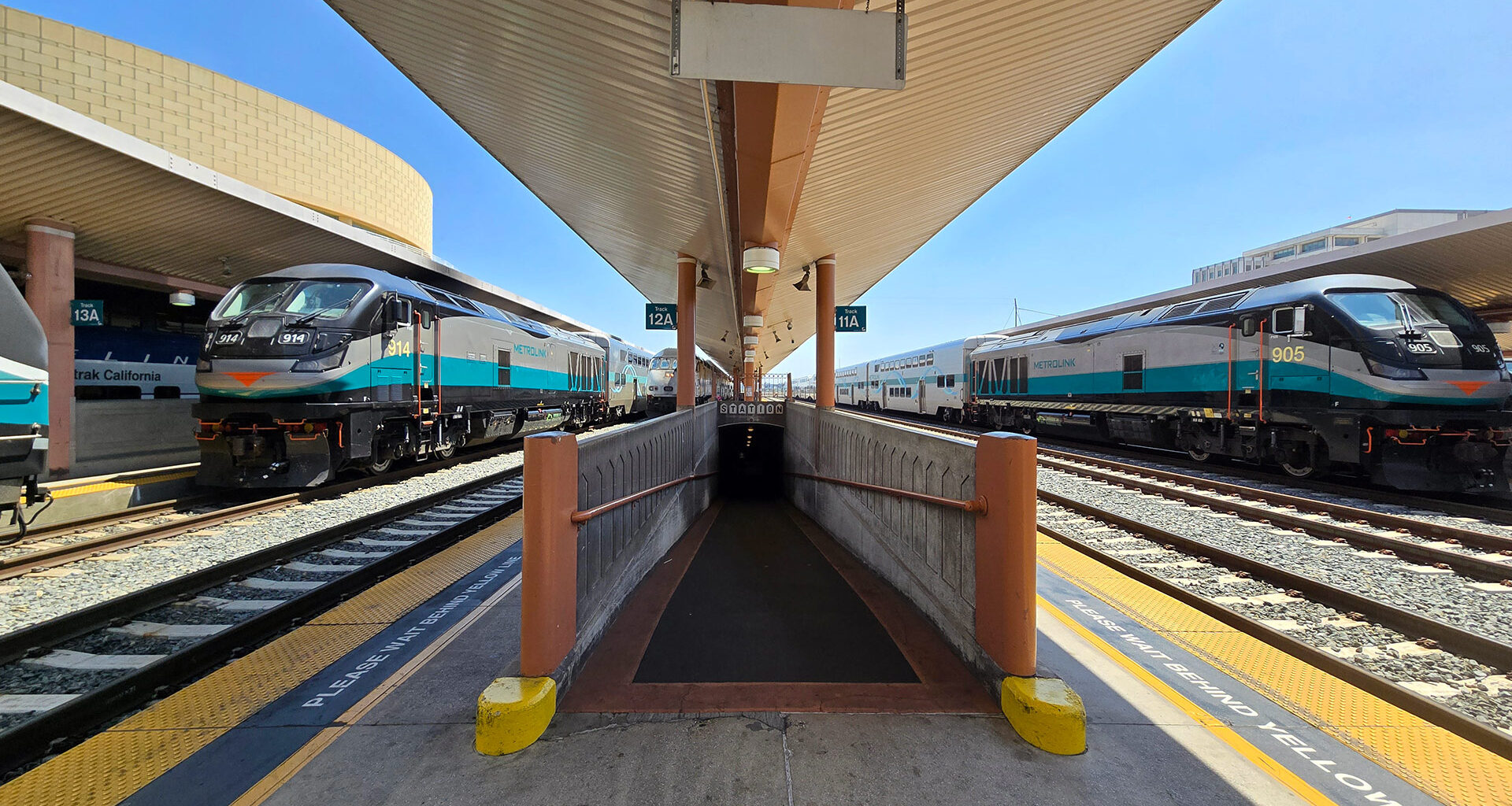
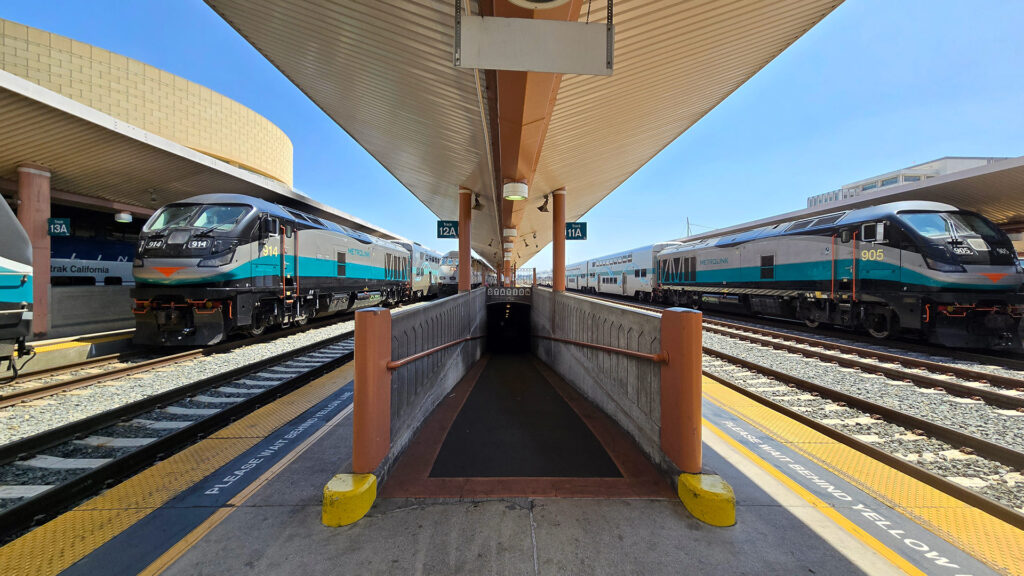
Six lines head out from Union Station in downtown LA, serving Los Angeles, Orange, Riverside, San Bernardino, Ventura, and San Diego counties. A seventh line connects the Inland Empire to Orange County and is the only suburb-to-suburb line in the United States. Think of it as the skeleton connecting Southern California’s major population centers, the framework that local transit systems (like Metro, OC Bus, and others) hang off of.
Trains run frequently on weekdays, less so on weekends. That weekend schedule matters: If you’re planning a Saturday beach trip to Oceanside, you need to know trains run much less frequently.
But here’s what makes it work: Metrolink connects to everything. Union Station in LA is the hub where all six lines meet—and it’s also a major Metro station. Most Metrolink stations connect to local bus systems. Many are near downtowns, beaches, or attractions specifically because they were built to serve communities, not just commuters.
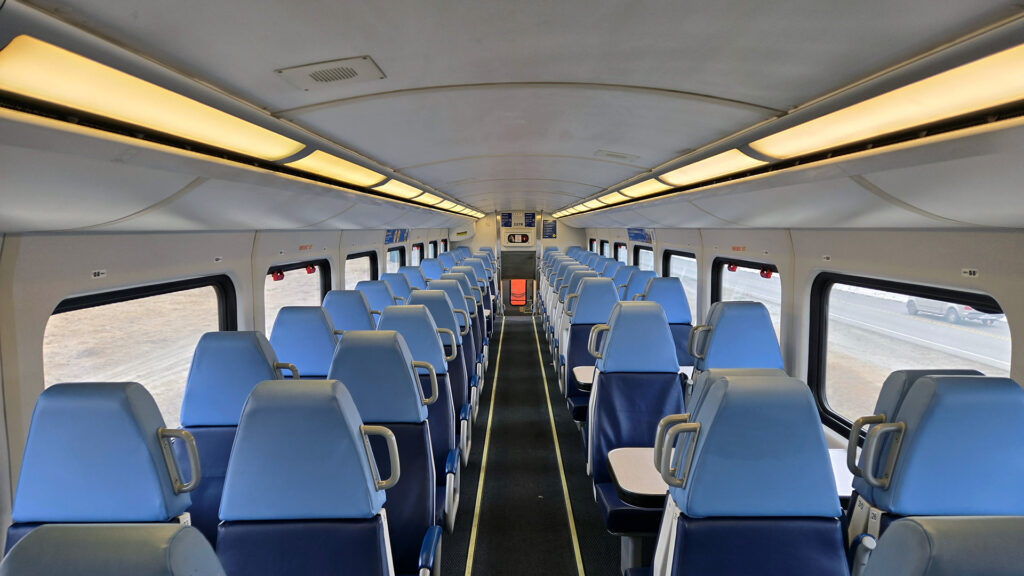
The trains themselves? Comfortable enough. Double-decker cars with plenty of seats, tables for working, bike racks on every train, and big windows perfect for watching Southern California’s surprising landscape diversity roll past.
The Practical Basics
Fares: Distance-based, ranging from around $5 for short trips to $20+ for the longest routes. Weekend Day Pass is your friend—$10 for unlimited rides systemwide on Saturdays or Sundays. That’s cheaper than a single round-trip on many routes.
Tickets: Buy through the Metrolink app, at station ticket machines, or with a TAP card (which also works on Metro). The app shows real-time arrivals and lets you buy tickets instantly.
Bikes: Every train has at least two bike cars with racks. No extra fee. Just roll your bike on, lock it in the rack, and ride. This matters because many Metrolink stations aren’t in walkable downtowns—having your bike extends your range dramatically.
Connections: At Union Station, Metrolink connects to every Metro line and the Flyaway to LAX. At Burbank Airport South, a 5-minute walk takes you to the front of the airport terminal. At Oceanside, it meets the Coaster heading to San Diego and the Sprinter to Escondido. Throughout the system, stations connect to local buses. Plan multi-modal: Metrolink + local bus + walking often gets you exactly where you need to go.
Skip the Airport Parking: Metrolink Gets You There
Here’s something most people don’t realize: Metrolink can eliminate one of the most stressful parts of air travel—getting to and from the airport.
Think about the usual airport experience. Leave home two hours early to account for traffic. Circle parking structures looking for spaces. Pay $20-40 per day to leave your car. Return from your trip exhausted, only to face the reverse: shuttle to the parking lot, find your car, drive home in post-flight brain fog.
Metrolink changes that equation entirely.
Burbank (BUR): The Easy One
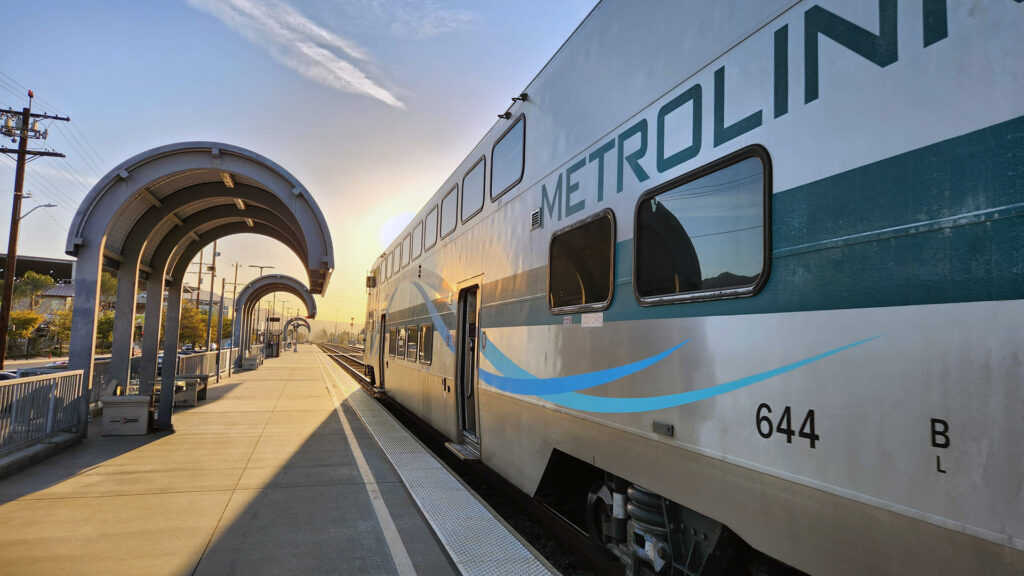
This is the simplest airport connection in Southern California. Metrolink’s Ventura County Line and Antelope Valley Line both stop at the Burbank Airport. The Ventura County Line stoped at Burbank Airport South, which is literally adjacent to the terminal. Walk off the train, down the platform, cross Empire Ave, and right into the airport terminal. Five minutes, door to door. The Antelope Valley Line stops at Burbank Airport North, which is about a mile northeast of the airport. Complimentary on-demand shuttle service between Burbank Airport North station and Hollywood Burbank Airport is available by calling (818) 729-2245. Note: Do not follow the Metrolink signage for the shuttle, as it tells you to wait at the north end of the platform. The shuttle now stops at the south end of the platform across from the Cambria Hotel Burbank Airport. On a nice day, it’s a simple 20-minute walk from the Burbank Airport North station and the terminal.
I use this regularly from Orange County. Board Metrolink in Fullerton, read or work for 35 minutes, transfer at Union Station, 20 minutes more, and walk straight into BUR from the South station. No traffic stress. No parking fees. No driving home after a long travel day.
The return is just as easy: Walk out of baggage claim, cross to the station, and catch the next southbound train. Done.
Pro tip: Check the schedule carefully. Weekday frequency is excellent for catching morning flights. Weekend service is sparser—plan accordingly.
LAX: One Extra Step
LAX doesn’t have direct rail service. But you can get there transit-only: Metrolink to Union Station, then the FlyAway bus directly to LAX.
The FlyAway runs every 30 minutes during peak times, takes about 40-55 minutes to the airport, depending on traffic, and costs $12.75 one-way. It’s a dedicated airport shuttle—luggage racks, comfortable seats, no stops between Union Station and LAX.
From Orange County: Metrolink to Union Station (about an hour), walk to the high end of the platform numbers, through Union Station East, and then head upstairs following the signs to the LAX Flyaway Bus (Bus Stop/Bus Bay 1). Total travel time is 2-2.5 hours, depending on connections, but you’re reading or working the whole time, not fighting I-110/105. You can purchase your Metrolink and Flyaway ticket directly through the Metrolink App. When boarding the Flyaway bus, scan your ticket on the reader on the stairs to your left. But be ready: the scanner usually beeps that it’s not a valid ticket, so show the driver your active Metrolink ticket, and they’ll wave you on board.
Cost comparison: Metrolink ticket + FlyAway = roughly $20-25 each way. Long-term parking at LAX = $40 per day. The math works after one day.
Ontario (ONT): The Inland Option
Ontario International is convenient if you’re east of LA, and Metrolink connects via the ONT Connector shuttle. Take Metrolink’s San Bernardino Line to Rancho Cucamonga station, then catch the free ONT Connector to the airport (runs every 20 minutes on weekdays, hourly on weekends).
This works particularly well if you’re already in the Inland Empire. From Orange County or LA proper, the routing gets more complex—Burbank or LAX might make more sense.
Santa Ana (SNA): The Rush Hour Special
John Wayne Airport in Santa Ana has a quirk: It’s really not accessible via public transportation. OCTA Route 472 serves the Metrolink station in Tustin, but there are only four trips in each direction, all during rush hour. Route 76 connects John Wayne Airport with Huntington Beach. If your flight timing aligns with the Metrolink schedule, it works. If not, you’ll need to take a rideshare for the last few miles.
Still, if you’re coming from northern Orange County or LA, using Metrolink to reach John Wayne Airport isn’t a good option.
Why This Matters
Airport access via Metrolink isn’t just about saving parking fees—though that’s real money. It’s about removing the single most stressful part of air travel: the drive to the airport, battling traffic while watching departure time approach, arriving wound up before you’ve even checked in.
Take Metrolink and you arrive relaxed. You’ve had time to mentally prepare for your trip. You haven’t spent the last hour gripping a steering wheel in traffic. And when you return, you’re not facing a drive home when you’re already exhausted.
That’s the transportation choice that actually serves you, not just gets you there.
Routes Worth Exploring
Orange County Line: LA to Oceanside
This is beach country. Fullerton (old downtown with breweries and music venues), Anaheim (yes, Disneyland, but also the Packing District), Santa Ana (artist district, Bowers Museum), San Juan Capistrano (the mission), San Clemente (surf town), Oceanside (pier, beach, connecting to San Diego’s Coaster).
The Saturday beach trip from LA? Take a morning Metrolink to Oceanside (about 2 hours), spend the day at the beach or pier, catch an evening train back. $10 Weekend Day Pass covers it. No parking stress, no Pacific Coast Highway traffic.
San Bernardino Line: LA through the Inland Empire
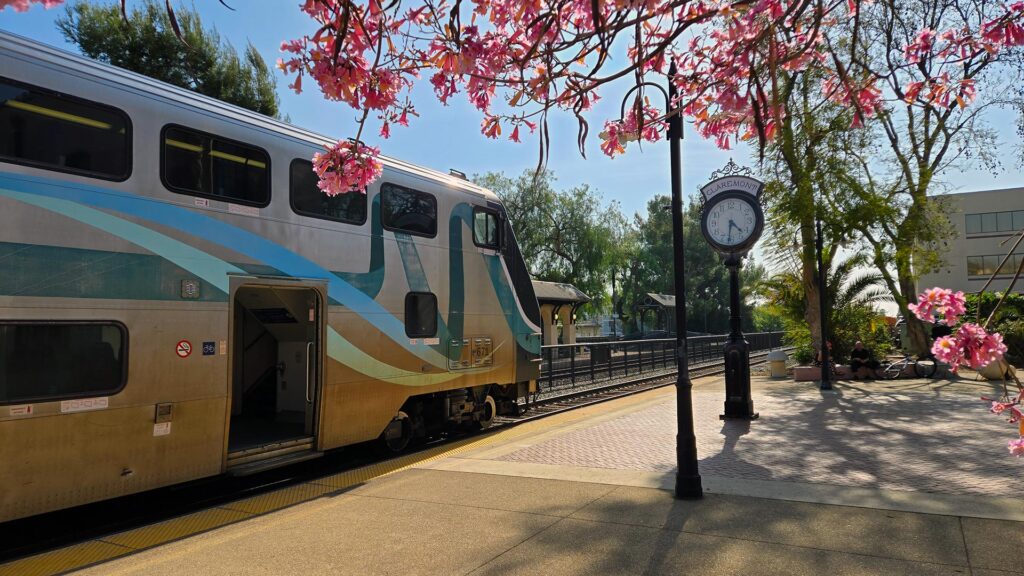
This route shows you the other Southern California, the one tourists skip. Through Pomona, Claremont (college town with a pleasant downtown), Upland, Rancho Cucamonga, and San Bernardino. Mountains visible to the north, suburban sprawl giving way to older town centers.
Less obviously tourist-oriented, but that’s the point. These are real communities with their own food scenes, parks, and local culture. Claremont alone is worth a Saturday—walkable village atmosphere, cafes, interesting shops, the kind of place that rewards wandering.
Riverside Line + 91 Line/Perris Valley: LA to Riverside
Two routes, one destination: Riverside, one of Southern California’s older cities with actual history and architecture. The Mission Inn is spectacular—a National Historic Landmark hotel worth seeing even if you’re not staying there. Downtown Riverside has a pedestrian mall, museums, and the kind of established urban fabric that newer Inland Empire cities lack.
Plus: The ride itself passes through interesting landscape transitions. Watching the geography change tells you something about how Southern California actually works as a region.
Making It Work: What I’ve Learned
Weekend schedules are sparse. Trains might run every 2-3 hours on Saturdays, even less on Sundays. Miss your train and you’re waiting. Solution: Treat the schedule as fixed appointments. Plan your day around departure times, not the other way around.
Station locations vary dramatically. Some stations are in downtowns (Fullerton, Claremont, Riverside). Others are in suburban parking lots, nowhere near anything walkable (Perris-South, Pedley). Research before you go. If the station isn’t walkable to your destination, plan for bike, local bus, or rideshare options for the last mile.
Bring your bike if you have one. Seriously. A bike transforms Metrolink from limited to liberating. Station to beach? Five-minute bike ride. Station to downtown? Easy. The bike racks on trains are excellent—this system was built assuming people would use bikes.
The Weekend Day Pass is genuinely useful. $10 for unlimited Metrolink rides all day means you can hop between destinations without calculating per-trip costs. Want to check out both Fullerton and Santa Ana in one day? Do it. The pass removes the psychological barrier of “spending more money” to change plans.
Connect through Union Station strategically. Most routes funnel through Union Station. If you’re staying in LA, that’s convenient—Union Station connects to Metro, so you can access Metrolink from anywhere Metro goes. If you’re making more complex regional trips, check if you need to transfer through Union Station or if a direct connection exists.
What You’re Actually Trading
Let’s be honest about the limitations: Metrolink is designed for commuters, not tourists. Weekend frequency reflects that reality, but service frequencies are getting better. You won’t have the spontaneous flexibility of Metro’s 10-minute headways.
But here’s what you gain: Access to a region that’s impossible to explore by Metro alone. Beach towns an hour south. Mountain communities to the east. Historic city centers spread across six counties. All without traffic stress, parking fees, or rental car costs.
The trade makes sense if your goal is exploring different communities across Southern California rather than maximizing time in LA proper. It’s the difference between deep diving into LA versus surveying the broader region.
Your Turn
Next time you’re in Southern California—or if you live here and haven’t tried it—pick a Metrolink route. Check the weekend schedule. Pick a destination. Go.
Maybe it’s Oceanside for the beach. Maybe it’s Riverside to see the Mission Inn. Maybe it’s Claremont just because you’ve never been there.
Bring a book for the ride. Watch the landscape. Notice how neighborhoods change as you move through the region. Arrive without the stress of highway driving.
See what you discover when you let the train determine the route instead of fighting traffic to predetermined destinations.
That’s the opportunity Metrolink offers: Not just transportation, but a different way of understanding Southern California as a region of connected communities rather than an endless sprawl you drive through without seeing.
Around the corner and around the globe—or in this case, from Union Station to the coast.
For complete details, visit metrolinktrains.com.